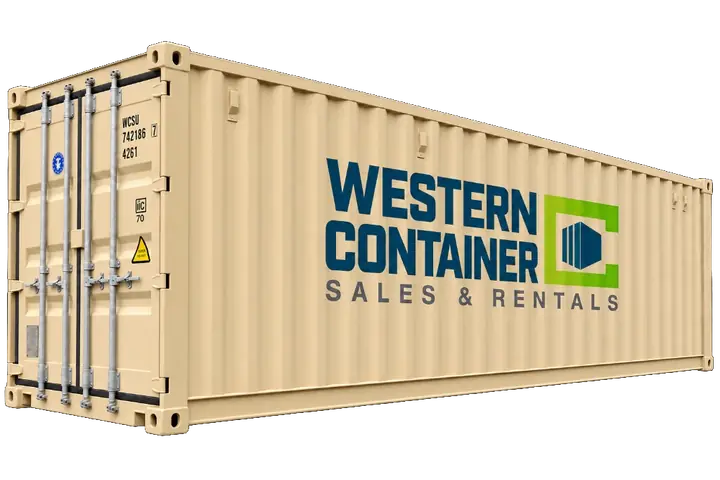
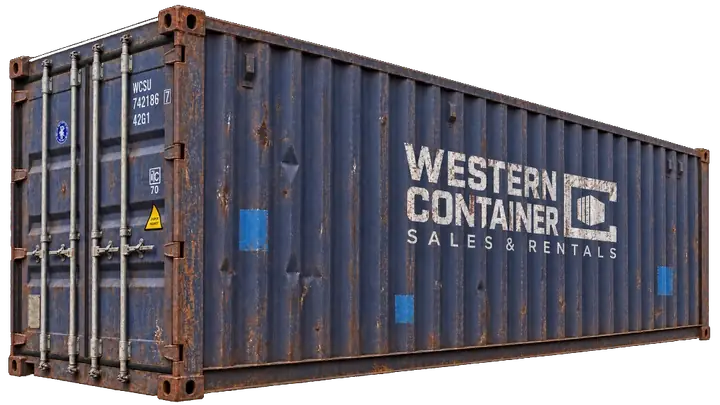
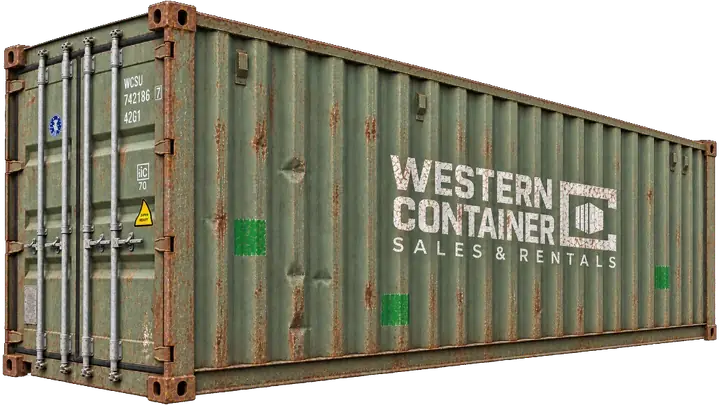
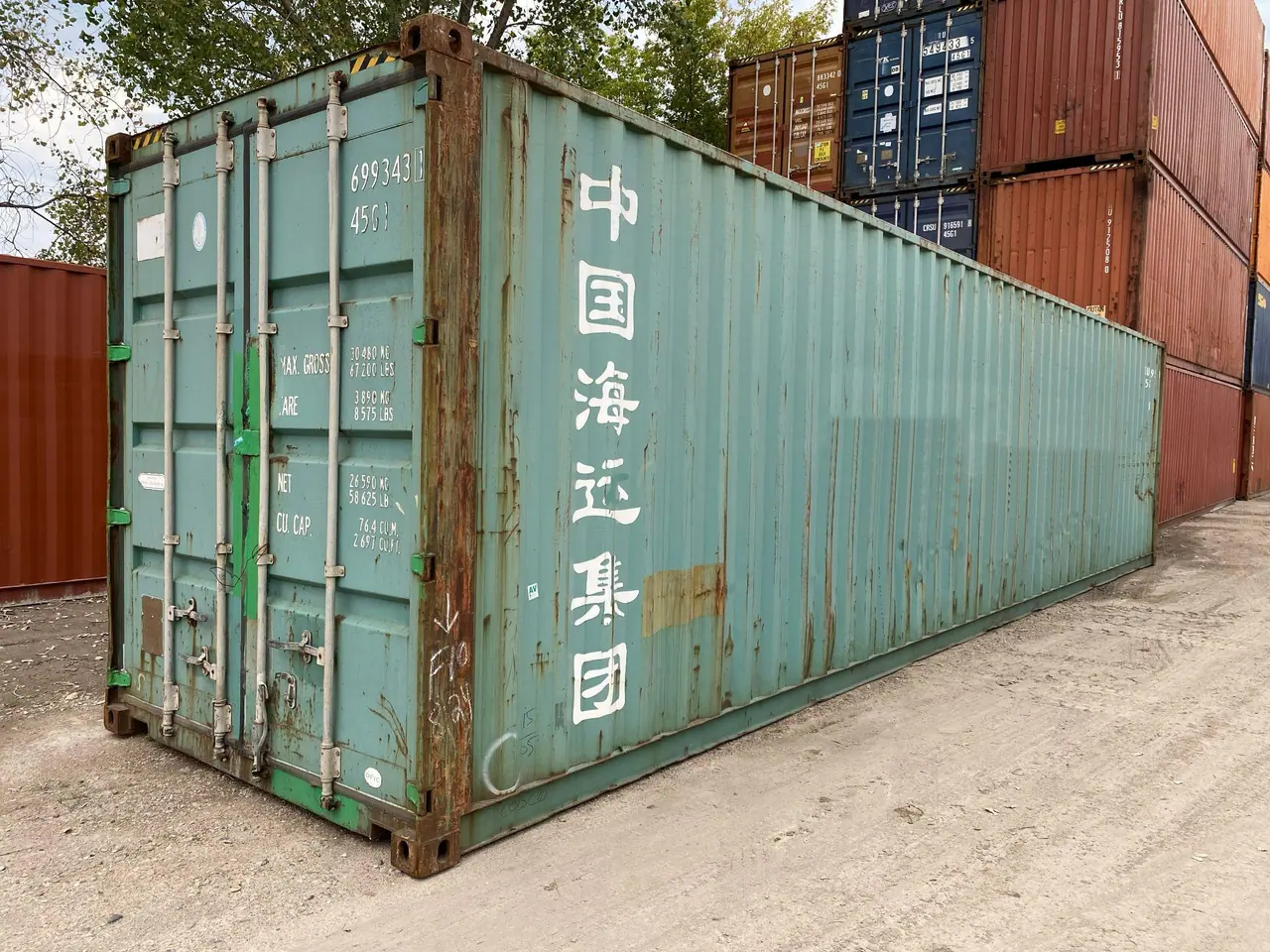
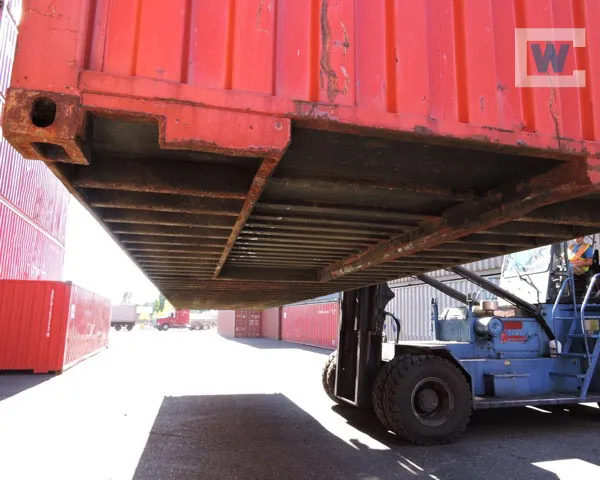
Used shipping containers are a byproduct of the intermodal cargo industry, so pricing is driven heavily by where the container happens to be sitting. Supply in the local market is the single biggest factor in what you will pay.
Container prices move constantly with supply and demand. Live pricing for new and used containers by market is always published on our locations pages and the shipping container prices matrix. No quote is guaranteed until payment is made, but any formal quote from our system updates automatically and emails you if the price moves up or down.
How Container Supply in Major Intermodal Hubs Impacts Pricing
In places with heavy shipping traffic like L.A./Long Beach, Chicago, Houston and Newark, used containers are readily available and prices are low. In markets where containers are less abundant, like the inland hubs of Salt Lake City, Denver, Nashville and Minneapolis, supply is tighter and prices run higher.
In most cases, coastal ports with the highest container volumes have the lowest prices. The main exceptions are inland ports like Chicago and Memphis, where containers pool and get emptied into warehouses and trucks for redistribution around the country. Beyond those exceptions, the best pricing is almost always at coastal container ports.
Largest U.S. Container Ports by Annual Volume
Approximate annual throughput in twenty-foot equivalent units (TEU), based on 2024 port-reported volumes. Figures move year to year; use them as a guide to relative scale, not as current-year data.
Ports of Los Angeles and Long Beach, CA: roughly 19 to 20 million TEU combined (busiest U.S. container gateway)
Port of New York & New Jersey: roughly 7.5 million TEU (largest East Coast port)
Port of Savannah, GA: roughly 4.8 million TEU
Port of Houston, TX: roughly 4.1 million TEU at public terminals (largest Gulf Coast container port)
Port of Virginia (Norfolk): roughly 3.5 million TEU
South Carolina Ports (Charleston): roughly 2.9 million TEU
Port of Oakland, CA: roughly 2.5 million TEU
NWSA (Seattle-Tacoma): roughly 2.4 million TEU
Port of Baltimore, MD: roughly 550,000 TEU
Port of Miami, FL: roughly 525,000 TEU
By comparison, Chicago handles container volume on the same order as L.A./Long Beach without being a seaport at all. Industry estimates put Chicago-area rail ramps at roughly 17 million TEU-equivalent lifts annually. Markets like Los Angeles, Newark, Savannah, Houston and Chicago almost always have the lowest container prices, because they almost always have the highest volume of containers on hand.
By contrast, the isolated intermodal market of Salt Lake City handles only about 225,000 TEU annually and often has some of the tightest container supply in the country. Prices in Salt Lake City are usually among the highest nationally, and other low-volume inland hubs like Denver and Nashville are right up there with them.
Size is affected by supply too. 40ft containers are not proportionally more expensive than 20ft containers, because 40ft units make up a disproportionate share of global shipping inventory. Price per foot on a 40ft container is meaningfully lower than on a 20ft.
Global Surpluses and Shortages Move Container Prices
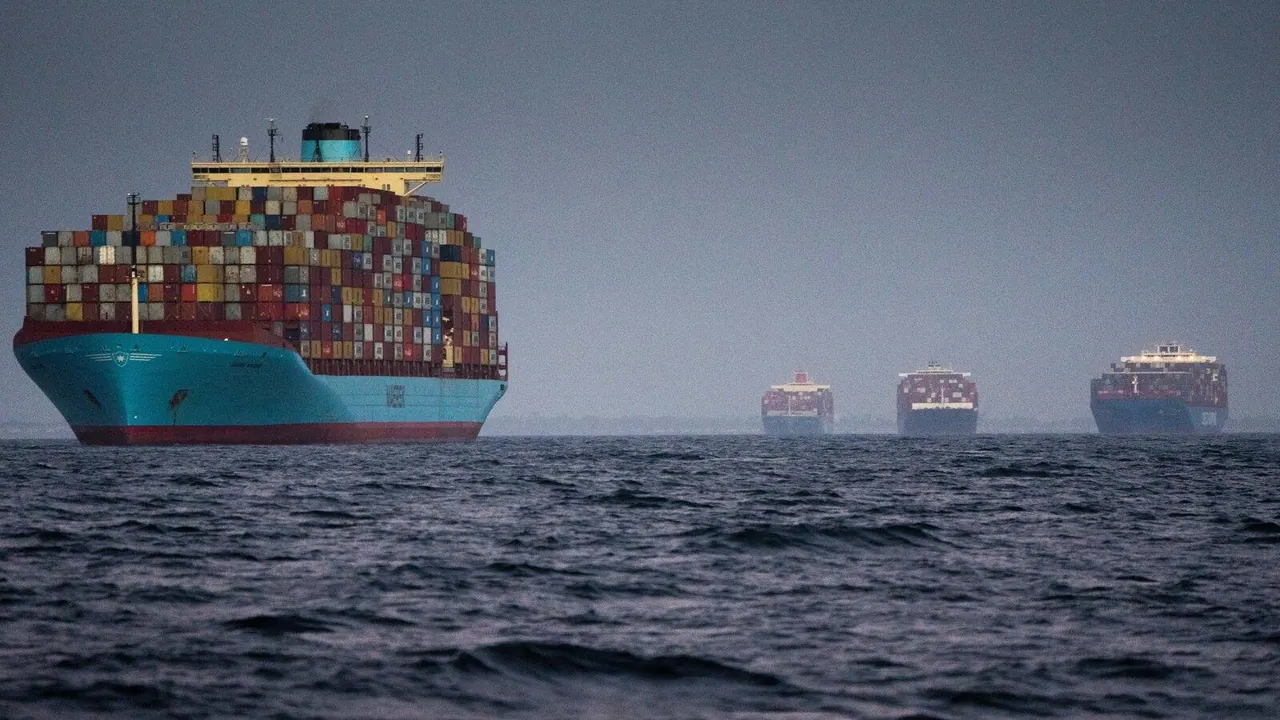
Pandemic-era port congestion tied up containers for months and pushed U.S. prices to record highs.
During the COVID-19 pandemic, supply chains were thrown into chaos and shipments that normally took a few weeks took six months or longer. More containers were needed to move the same amount of freight because equipment sat idle at ports. Ships queued for miles outside major terminals, and once containers were emptied they were often sent straight back to Asia for cargo already waiting to load. Finding a container in the United States became difficult and prices surged more than 200% above 2019 levels. A used 40ft high cube in Los Angeles that would have been $1,500 in 2019 was selling for $4,500 in 2022.
The pace created knock-on problems. The Suez Canal was blocked by a grounded container ship after the canal had been run at record volumes for months. Ports everywhere were at a breaking point. The unpredictability of restocking pushed a lot of businesses to add storage capacity, driving container prices up further still.
Supply chains have since stabilized and pricing has come back down to more normalized levels. The global container fleet is now at an all-time high while ports and shipping lines operate at far more manageable volumes than during the pandemic. That combination of record equipment supply against normalized demand is why a meaningful correction in used container pricing is a real possibility later this decade. It is worth understanding what that can look like, because it has happened before.
What a Supply Shock Looks Like: The Hanjin Collapse
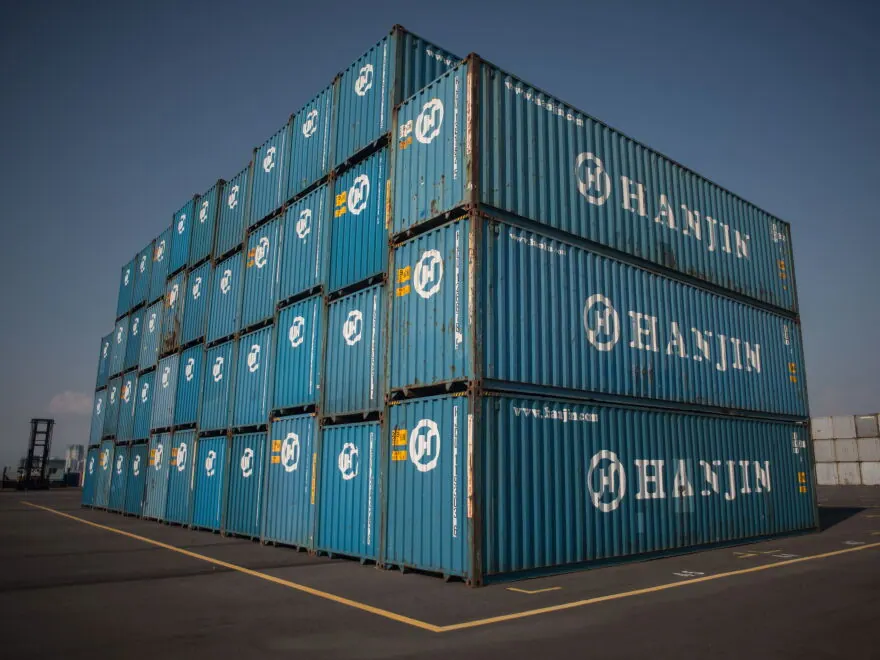
Hanjin was the seventh-largest shipping line in the world when it closed abruptly in 2017.
Hanjin was the seventh-largest shipping line in the world when it closed abruptly in 2017 due to bankruptcy. With more than 600,000 TEU in its fleet, hundreds of thousands of containers suddenly needed to be liquidated out of stacks at ports and depots around the world.
Even though Hanjin represented only about 3% of global container capacity, the unexpected dumping of equipment collapsed pricing. Wind and watertight 40ft containers sold for as little as $900 in some ports, and prices were depressed even in markets with little Hanjin presence, purely because of the surplus.
Shipping Container Sizes and Dimensions
Containers are measured in twenty-foot equivalent units, or TEUs, with 20ft and 40ft being by far the most common. Sizes are set by outside dimensions, so a 40ft container does not give you 40ft of interior space. It means the container is 40ft long from outside edge to outside edge. Compare the three sizes we most often sell on Container Sizes & Types.
There are less common sizes like 45ft and 53ft containers. Those are rarer because they are too long to maneuver on some roads in parts of Europe and Asia. 45ft containers are somewhat common internationally but still unusual. 53ft containers are used mainly in North America, moving between truck and rail, and almost never go on a cargo ship.
There are also 10ft containers, though they are almost never shipped at that length. They are cut down from larger units after cargo is emptied, usually “duocon” 20ft units that get cut in half, with a bulkhead welded onto each new container to seal it off. That labor is why 10ft containers tend to be the most expensive size despite being the smallest.
10ft Shipping Containers
10ft containers are cut down from larger units, so they are not exactly 10ft long.
The most expensive container per foot is the 10ft. Because containers are never stacked in 10ft lengths, every one is cut down from a larger unit after the cargo is emptied out.
10ft containers are not available in every market and usually start around $3,900 or more, reflecting the cost of cutting the container down and re-welding a bulkhead onto it.
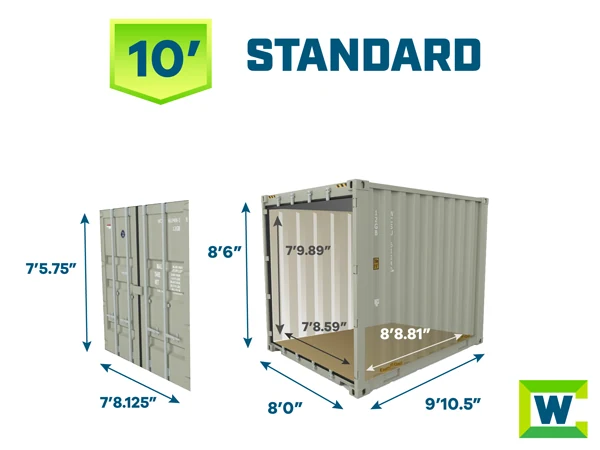
Because a 10ft container is cut from a 20ft, it is not exactly 10ft long. The exterior is about 9ft 10.5in, with the standard 8ft exterior width and 8.5ft exterior height. Interior height matches a 20ft or 40ft standard at 7ft 9.89in, and interior width is slightly smaller at 7ft 8.59in. Interior length is only 8ft 8.81in, so storage space is genuinely tight.
Measurement, exterior, and interior / door opening.
Measurement
Exterior
Interior / Door
Length
9ft 10.5in
8ft 8.81in interior
Width
8ft
7ft 8.59in interior / 7ft 8.125in door
Height
8ft 6in
7ft 9.89in interior / 7ft 5.75in door
20ft Shipping Containers
A 20ft container is about the footprint of a parking stall, a little narrower and a little longer.
A 20ft container is about the footprint of a parking spot, a little narrower and a little longer, so expect it to stick out a couple of feet past the end of a standard stall.
Interior cubic footage is similar to a single-car garage, which is a useful mental benchmark when you are estimating how much you can fit.
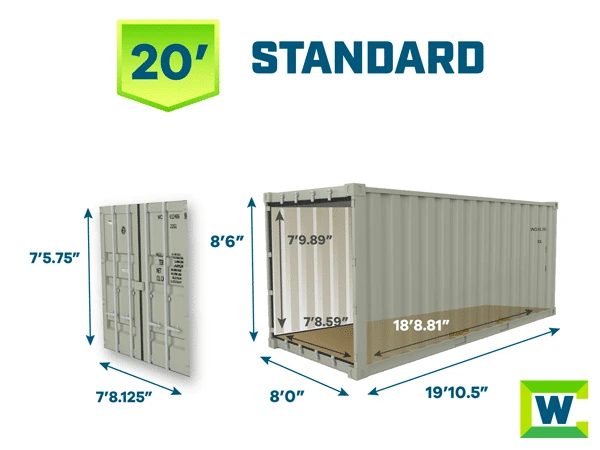
Because 20ft containers are stacked alongside 40ft containers on rail and on ships, they are actually a bit shorter than 20ft to leave room for the corner connectors that lock stacks together. Exterior length is 19ft 10.5in, which brings interior length to 18ft 8.81in. Interior height is 7ft 9.89in and interior width is 7ft 8.59in. See Buy 20ft Containers for current options.
Measurement, exterior, and interior / door opening.
Measurement
Exterior
Interior / Door
Length
19ft 10.5in
18ft 8.81in interior
Width
8ft
7ft 8.59in interior / 7ft 8.125in door
Height
8ft 6in
7ft 9.89in interior / 7ft 5.75in door
20ft containers are usually cheaper than 40ft containers, but not by much. The discount is not proportional to size, and a 20ft is more expensive per foot. Where they win is fit: tight jobsites, crowded retail lots, and residential properties.
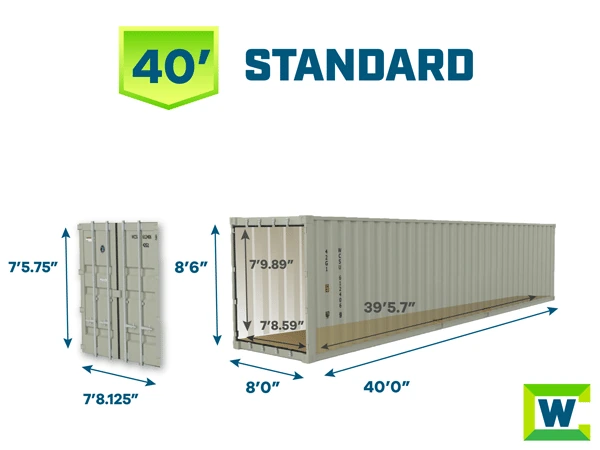
40ft Standard Shipping Containers
40ft standard containers are the same height and width as 20ft containers, just 40ft long.
40ft standard containers are the same height and width as 20ft containers, just 40ft long. They are becoming rarer.
Up until the mid-2010s shipping lines charged a surcharge for high cube containers. When that stopped, production shifted almost entirely to high cubes at the 40ft length. (20ft high cubes remain rare, because the center of gravity causes problems in a shorter, taller box.)
Cargo containers typically stay in circulation about 12 to 15 years, so by roughly 2030 the 40ft standard height will be uncommon as new production continues to favor high cubes.
40ft standards are still readily available used, but they are harder to find, and usually more expensive, in One Trip condition. A used 40ft standard typically runs only about $100 less than a 40ft high cube, so the discount is rarely meaningful and most customers opt for the high cube. Current 40ft options live on Buy 40ft Containers.
Measurement, exterior, and interior / door opening.
Measurement
Exterior
Interior / Door
Length
40ft
39ft 5.7in interior
Width
8ft
7ft 8.59in interior / 7ft 8.125in door
Height
8ft 6in
7ft 9.89in interior / 7ft 5.75in door
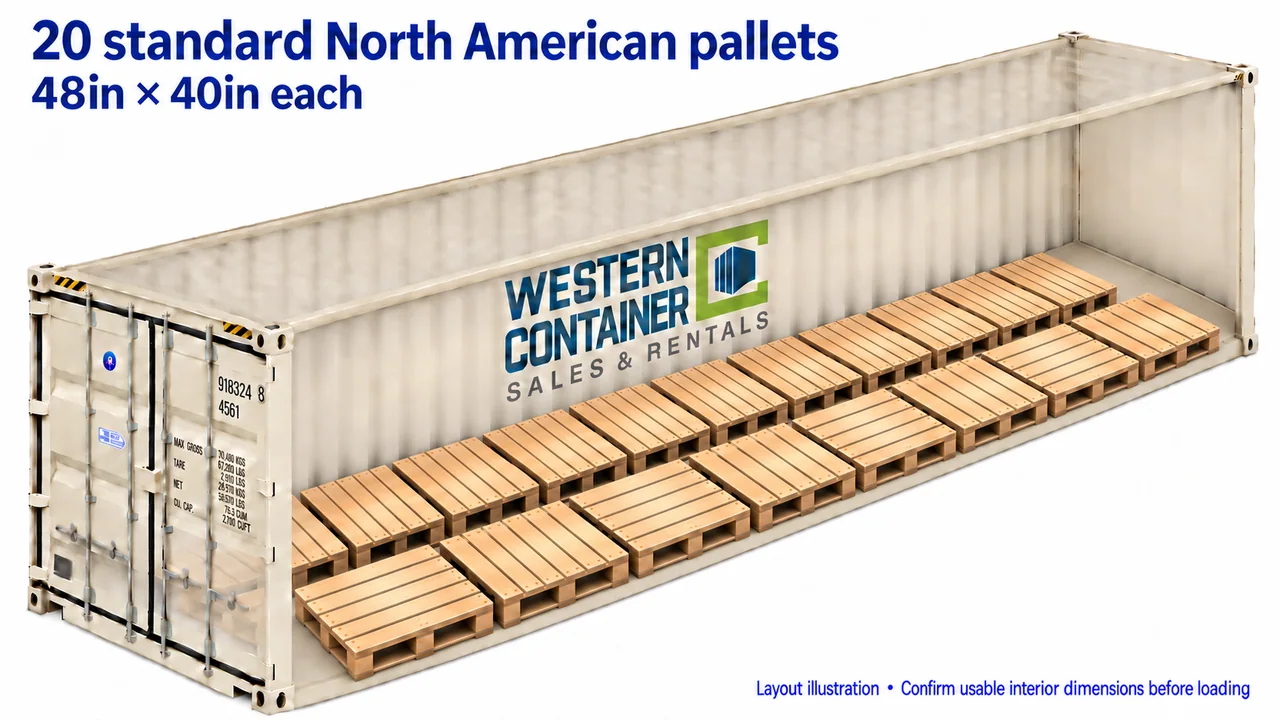
A 40ft container holds roughly 20 to 21 standard North American pallets, or about 24 Euro pallets.
40ft High Cube Containers
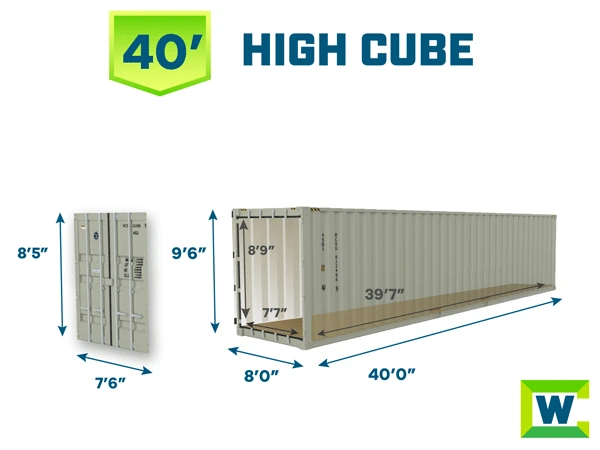
40ft high cubes add an extra foot of exterior height and more than 12% more cubic storage than a standard-height container.
40ft high cubes are the most common container produced today. It is estimated that upwards of 85% of all new container production is 40ft high cube.
High cubes add an extra foot of exterior height, which works out to over 12% more cubic storage space than a standard-height container.
Interior height gains about 11.5in versus a standard container, even though the exterior is a full foot taller. Interior height is 8ft 9in and interior width is 7ft 7in, slightly over an inch narrower than a standard-height container.
The door opening is 8ft 5in tall by 7ft 6in wide, which matters more than it sounds: most warehouse forklifts drive into a high cube with no issue, where they may need to tilt the mast back to get into a standard-height container. Pallet capacity is the same as a 40ft standard at 20 to 21 standard pallets, or about 24 Euro pallets. See Buy 40ft High Cube Containers.
Measurement, exterior, and interior / door opening.
Measurement
Exterior
Interior / Door
Length
40ft
39ft 5.7in interior
Width
8ft
7ft 7in interior / 7ft 6in door
Height
9ft 6in
8ft 9in interior / 8ft 5in door
45ft High Cube Containers
45ft high cubes are uncommon and almost never available in One Trip condition.
45ft high cubes are uncommon but they do exist. They are almost never available in One Trip condition and we only offer them used.
They also tend to stay in cargo circulation longer than most containers. Because they are rare, shipping lines hold onto them so they have them available when a customer needs one.
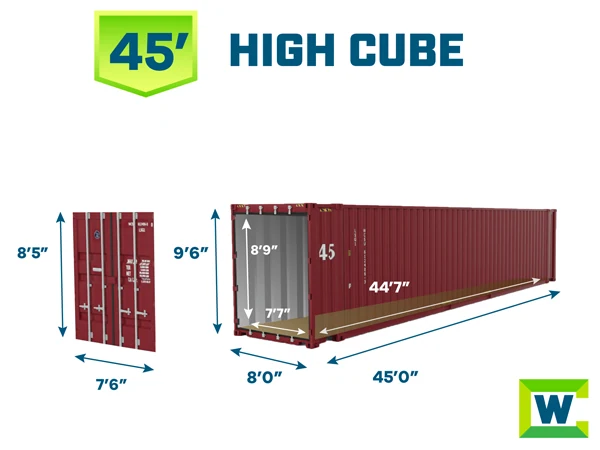
Interior height and width are identical to a 40ft high cube: 8ft 9in and 7ft 7in. The door opening is 8ft 5in tall and 7ft 6in wide. Interior length is 44ft 7in, giving capacity for up to 24 standard pallets or 27 Euro pallets. When we have them, they appear on Buy 45ft High Cube Containers.
Measurement, exterior, and interior / door opening.
Measurement
Exterior
Interior / Door
Length
45ft
44ft 7in interior
Width
8ft
7ft 7in interior / 7ft 6in door
Height
9ft 6in
8ft 9in interior / 8ft 5in door
There is also a “pallet wide” version of the 45ft high cube that holds up to 26 standard pallets or 33 Euro pallets. They are extremely rare and we do not offer them for sale.
Shipping Container Conditions and Grades
Intermodal shipping lines categorize containers into five main grades. Start with our container conditions hub if you want the short version for storage versus export.
One Trip (like new) • IICL (Institute of International Container Lessors) • Cargo Worthy (CWO) • Wind and Watertight (WWT) • As-Is (usually damaged)
There is no industry grade called “A-grade” or “B-grade.” Those labels are not used by intermodal companies, and because they are subjective, one seller’s “A-grade” may be another seller’s “C-grade.” If a seller is grading containers by letter, ask them which of the five industry grades they actually mean before you buy. See What is an A-grade shipping container?.
One Trip Shipping Containers
One Trip containers have taken exactly one trip across the ocean with cargo inside.
One Trip containers have taken exactly one trip across the ocean with cargo inside. They are technically not “new,” but they are often called “like new” because they were manufactured in the last year or two and have only carried cargo once. The vast majority of new shipping containers are manufactured in China, so there is effectively no supply of truly new containers in the U.S. unless you custom build one from the ground up, which usually runs double or triple the cost of a One Trip. Full detail: One Trip containers.
Expect a few scrapes and dents from stacking and unstacking at the ship and the depot, but otherwise they look essentially new. The most common complaint we hear is a strong paint smell inside, because the doors were sealed right after the container left the factory. Leaving the doors open for a day or two almost always clears it.
Most One Trip containers come in neutral colors like beige or gray, with RAL1015 (light ivory) the most common. Doors open smoothly and the units look clean. If the budget allows, we recommend One Trip.
IICL Containers (Institute of International Container Lessors)
IICL-grade containers are used cargo-worthy containers held to a tighter structural standard than CWO. Dents on IICL units are smaller, but that does not mean they look better. IICL containers are sometimes uglier than CWO units, because dents get cut out and patched, leaving welding scars and mismatched paint.
We do not sell IICL containers. In our experience customers feel misled when a unit arrives looking no different from a WWT or CWO container despite costing considerably more. Unless you plan to put your container on a cargo ship for years, you almost certainly do not need IICL grade.
CWO Containers (Cargo Worthy)
CWO is a structural grade, not a cosmetic one.
Used cargo-worthy containers are usually 10 to 15 years old, still structurally sound, and capable of being stacked up to seven high while loaded on a cargo ship. Read Cargo Worthy and CWO vs WWT.
To put that in perspective: if each loaded container weighs up to 50,000 pounds, the bottom container in the stack has to carry up to 300,000 pounds on top of it without the stack collapsing.
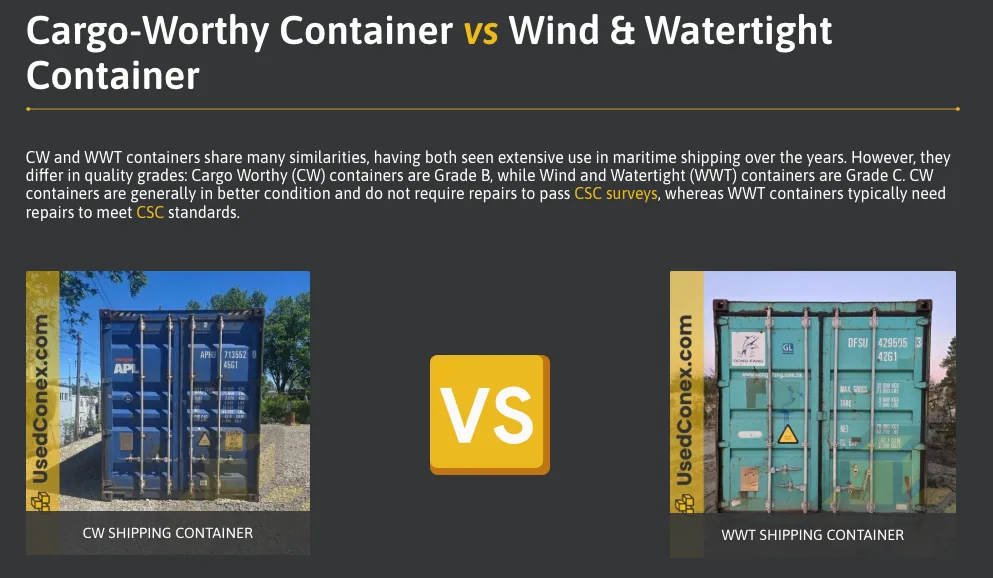
CWO is a structural grade, not a cosmetic one. A CWO container will not look any better than a WWT container. Both will have surface rust and dents. The only real difference is that a CWO unit can pass a CSC inspection and a WWT unit might need a small repair first.
Buy CWO only if you intend to export. For storage use it is money spent on a certification you will never use.
WWT Containers (Wind and Watertight)
Wind and watertight is the most common container we sell.
Wind and watertight is the most common container we sell. WWT units are usually 12 to 15 years old. See Wind & Water Tight.
They have been retired from cargo circulation because they can no longer be stacked seven high while loaded, which has nothing to do with how well they work as storage containers.
WWT containers are still used frequently for domestic cargo on trucks and trains, where they are only stacked two high while loaded. If you are buying for storage, WWT is the way to save real money on a durable steel box that will last for decades with minimal maintenance.
What to Expect Your Container to Look Like
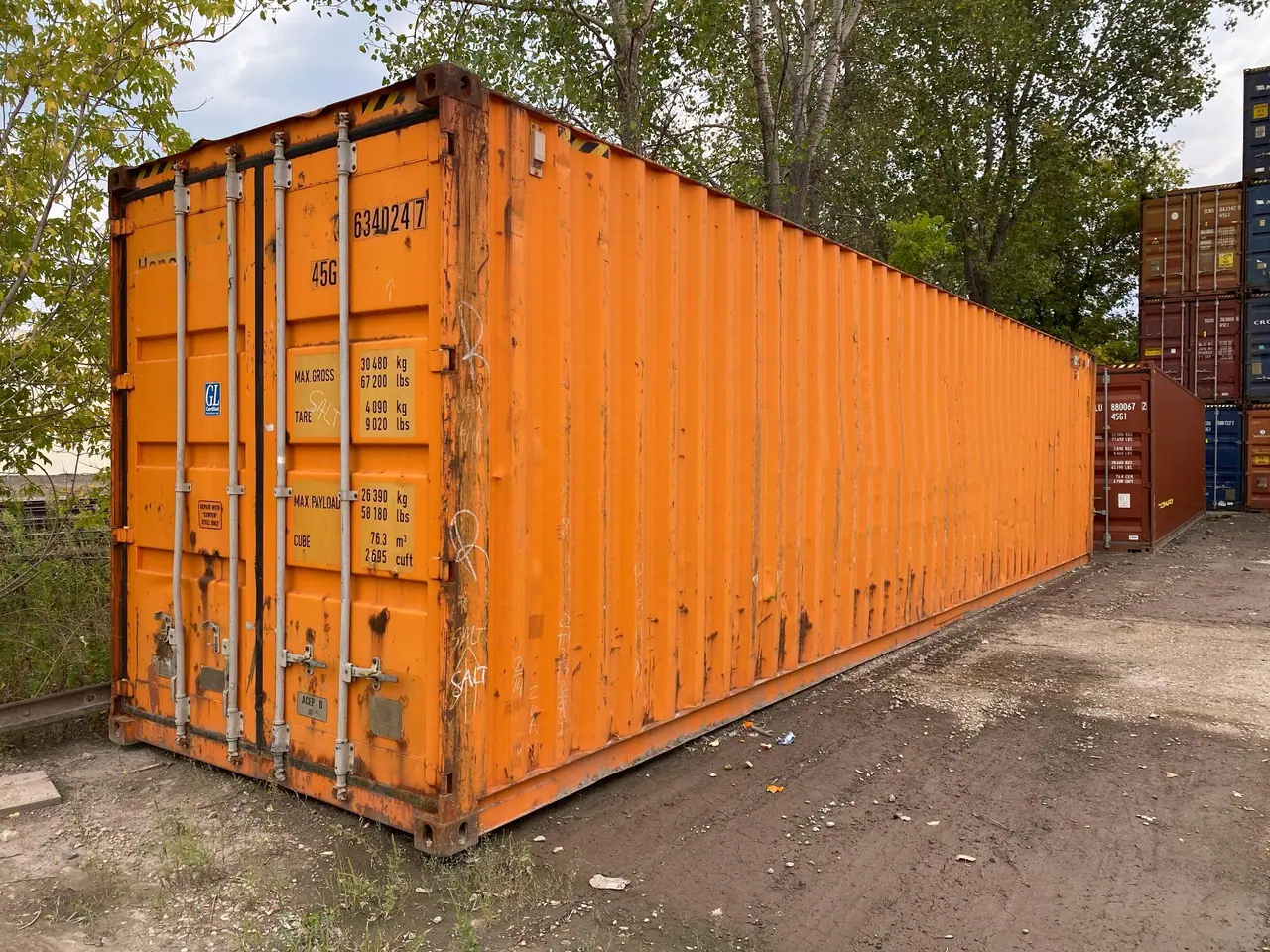
Used shipping containers are ugly. All of them have surface rust and dents. If you order a WWT or CWO container, expect it to look like a steel box that has been out on the ocean for over a decade. Surface rust, paint scrapes, patches, dents and other cosmetic blemishes are all normal.
Surface rust and faded paint are normal on used containers.Dents, scrapes and patches come with a box that has been in cargo circulation.
Mismatched paint and patches are cosmetic, not a defect in a WWT or CWO unit.
If cosmetic condition matters to you, you have two options: plan to paint the container after it arrives, or order a One Trip container.
Some companies market their used containers as better-looking than everyone else’s. Cosmetic condition is subjective and inconsistent across any used fleet, so we would rather set low expectations and let the container beat them. What we will commit to is structural integrity. Every container we sell comes with our 3-year structural warranty.
How to Spot Misleading Marketing and Container Scams
There are plenty of reputable container sellers out there, and we compete with them on price and service. But some marketing in this industry is deliberately misleading, and some sellers are outright scams. Here is how to tell the difference before you send anyone money.
The examples below reflect publicly available information from company websites, published review incentives and filed complaints as of publication. Practices change, so verify anything you are relying on directly with the seller.
Check Customer Reviews Before You Buy
Any reputable container company will have years of online reviews you can read. Western Container Sales has been collecting Trustpilot reviews for years and has been accredited by the Better Business Bureau since 2017 with an A+ rating. Check the reviews of any company you are considering. A thin review history is a red flag.
Watch for Paid and Incentivized Reviews
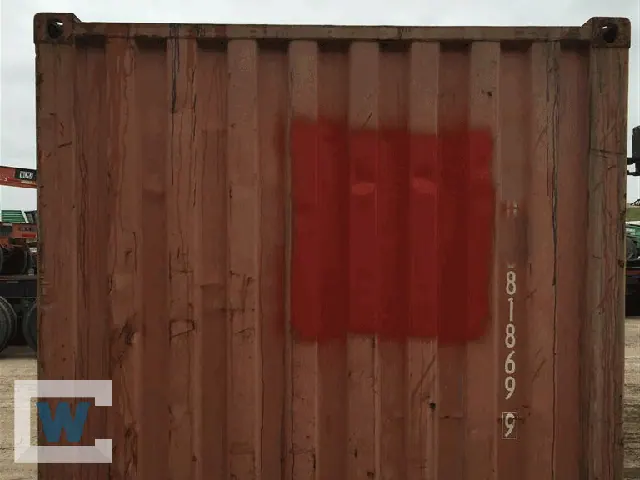
Some sellers pay for positive reviews outright. Conex Depot has advertised a $100 cash payment to customers who submit a positive video review of their container purchase. Used Conex has advertised a $200 rebate for customers who send in a video meeting their guidelines, which include naming the company and mentioning their sales agent.
A published $100 cash incentive for a positive video review.A published $200 rebate contest for videos that mention the company and sales agent.
Two published review-incentive offers. Paying for the review changes what the review is worth.
Incentivized reviews dilute the honest negative feedback that would otherwise tell you what buying from that company is actually like. You will also see companies with templated reviews that repeat nearly word for word under different customer names.
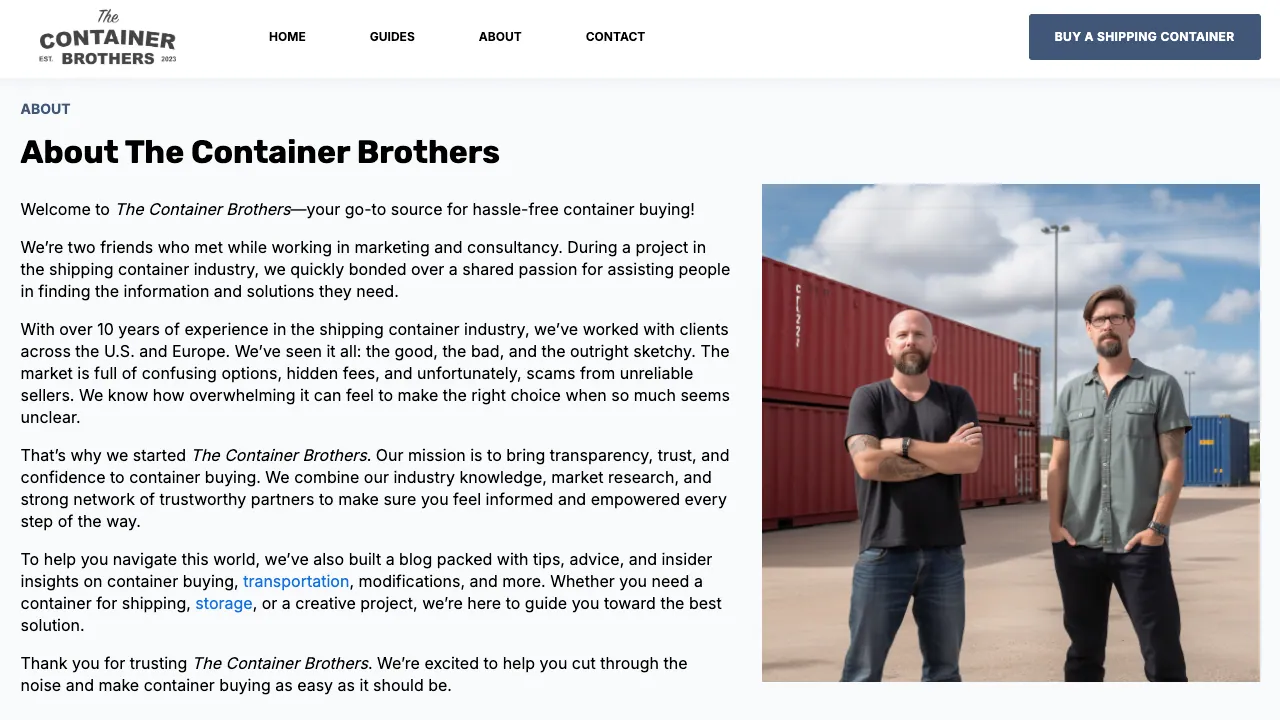
Eveon Containers operates a site called The Container Brothers, which presents itself as an independent resource, describing itself as a starting point for buying shipping containers and offering advice from container experts. It is not independent. Forms submitted through that site route to Eveon.
Look closely at the photography. The containers do not have the proportions or hardware of real units.
Be Careful With Facebook Marketplace and Craigslist
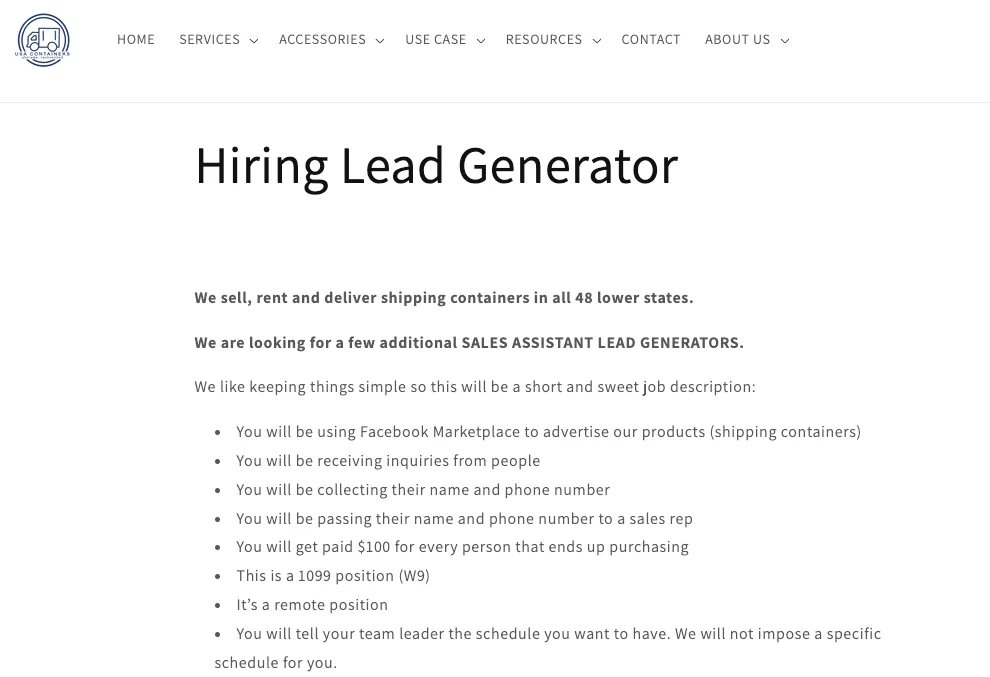
A number of companies do most of their marketing on Facebook Marketplace or Craigslist, and in many cases you are not dealing with the company at all, but with an independent contractor aggregating leads. USA Containers publishes the job description on their own website:
So you are not talking to a container expert, you are talking to someone collecting your contact information for a sales rep to call later.
In our experience that leads to missed expectations, problems at delivery and frustrating customer experiences.
Outright Scams
The bigger risk on marketplace sites is straightforward fraud: a price that is too good to be true, a request for a partial deposit up front with the balance due at delivery, and then the driver never shows up. Bad actors use fake invoices and container photos pulled from elsewhere online to look legitimate.
Even the marketplace sellers who are not scams are usually third-party agents earning a commission for handing your contact information to another company. Paying everyone along that chain tends to make the final price higher, not lower. You are generally better off starting with a reputable company directly.
Watch for a Track Record of Overpromising
Plenty of container companies will promise the best container at the lowest price on the fastest timeline. When you hear that, check their reviews and their Better Business Bureau profile.
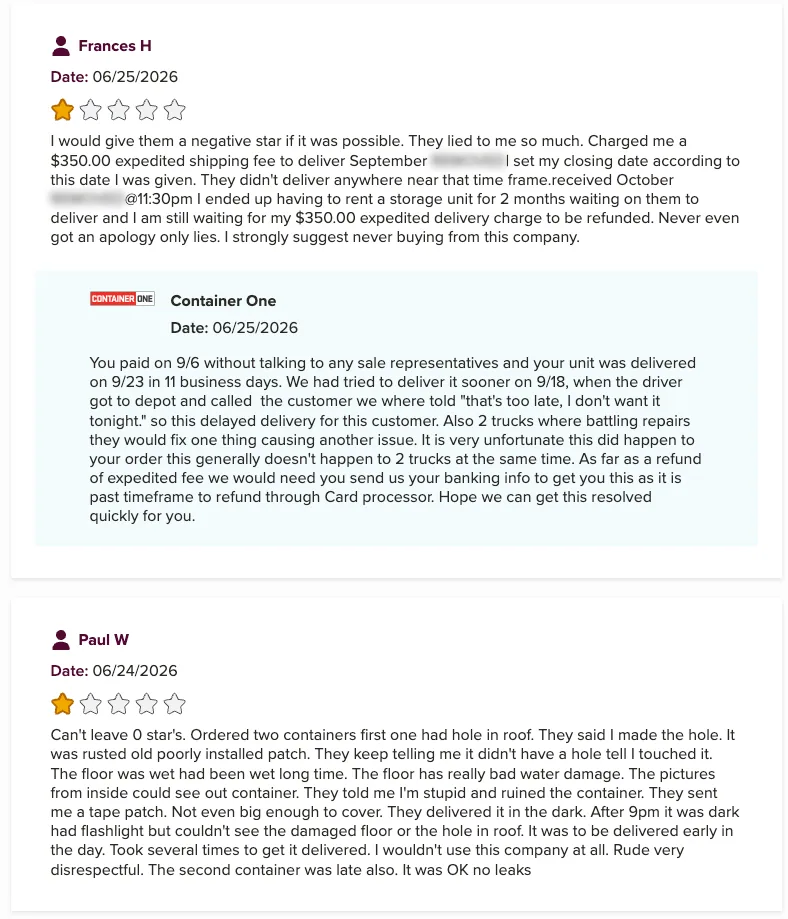
Container One is one example where the marketing and the publicly filed BBB complaints tell different stories. Missed delivery timelines, unresponsive customer service when something goes wrong, and disputes with customers about the condition of the container at delivery are recurring themes on their BBB profile.
When a customer feels they have to file a public complaint, it is usually because they are not getting anywhere with the company that sold them the container.
Things do occasionally go wrong when you are delivering 40ft steel boxes. In our experience the right way to handle that is to communicate directly with the customer and work to a resolution. We are not perfect, but we stand behind our warranty and we work the problem.
Do Not Pay Inflated Prices to Cover Sales Commissions
Many container sellers pay agents substantial commissions, and often those agents are not even employees. Some companies run an office of commissioned reps calling leads; others pay third-party “agents” as independent contractors who earn commission on their sales. USA Containers advertises a 10% commission to reseller agents, which appears to be in addition to what they pay lead generators.
Western Container Sales does not pay commissions to sales agents, which is part of how we keep prices below competitors who do.
Check the Fine Print on Container Warranties
We offer a 3-year structural warranty on used shipping containers. Some competitors advertise longer terms of 10 years, 25 years, even “lifetime,” but the term length matters far less than what the warranty actually covers and how hard it is to use.
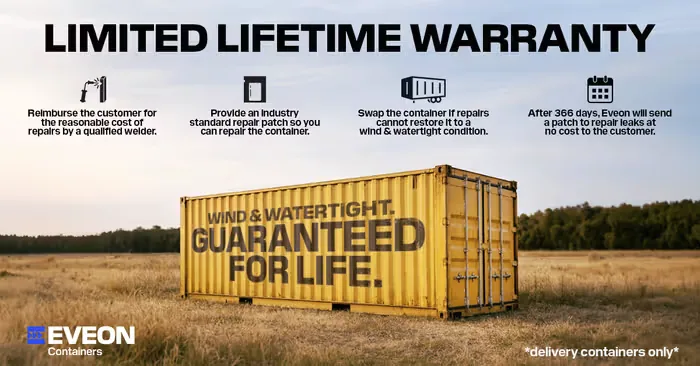
Eveon advertises a “limited lifetime warranty,” but the fine print covers holes in the roof only, and they do not repair the container.
Eveon advertises a “limited lifetime warranty,” but the fine print covers holes in the roof only, and they do not repair the container. They send you a patch to apply yourself. The full-coverage portion is one year. When you check customer reviews on companies with long advertised warranties, you will frequently find complaints about work that was not covered or never completed.
Be Skeptical of Cosmetic Claims About CWO Containers
CWO is a structural certification. It says nothing about appearance.
As covered in the conditions section, CWO is a structural certification. It means a container can be safely stacked while loaded with roughly 40,000 pounds of additional cargo weight per container. It says nothing about appearance, and a CWO container will not look better than a WWT container.
If a seller tells you CWO containers are cosmetically nicer, or grades containers as “A-grade” and “B-grade,” treat it as a signal to ask more questions. For storage use, paying the CWO premium buys you a certification you will never need.
Local Regulations and Required Permits
Generally speaking, “shipping containers” are not specifically regulated. Most municipalities instead regulate “temporary storage structures” and similar categories. There is a lot of variability city to city, but in most cases containers are straightforward on commercial and industrial zoning and get more complicated on residential. HOAs are their own separate game, with even more variability. See Do I need a permit for a shipping container?.
Permits are usually only required if a container will sit on the street or block a sidewalk. Most of the time containers are not subject to building permits, because they are not part of a building and are typically treated as a temporary structure like a toolshed or a trailer.
Commercial and Industrial Properties
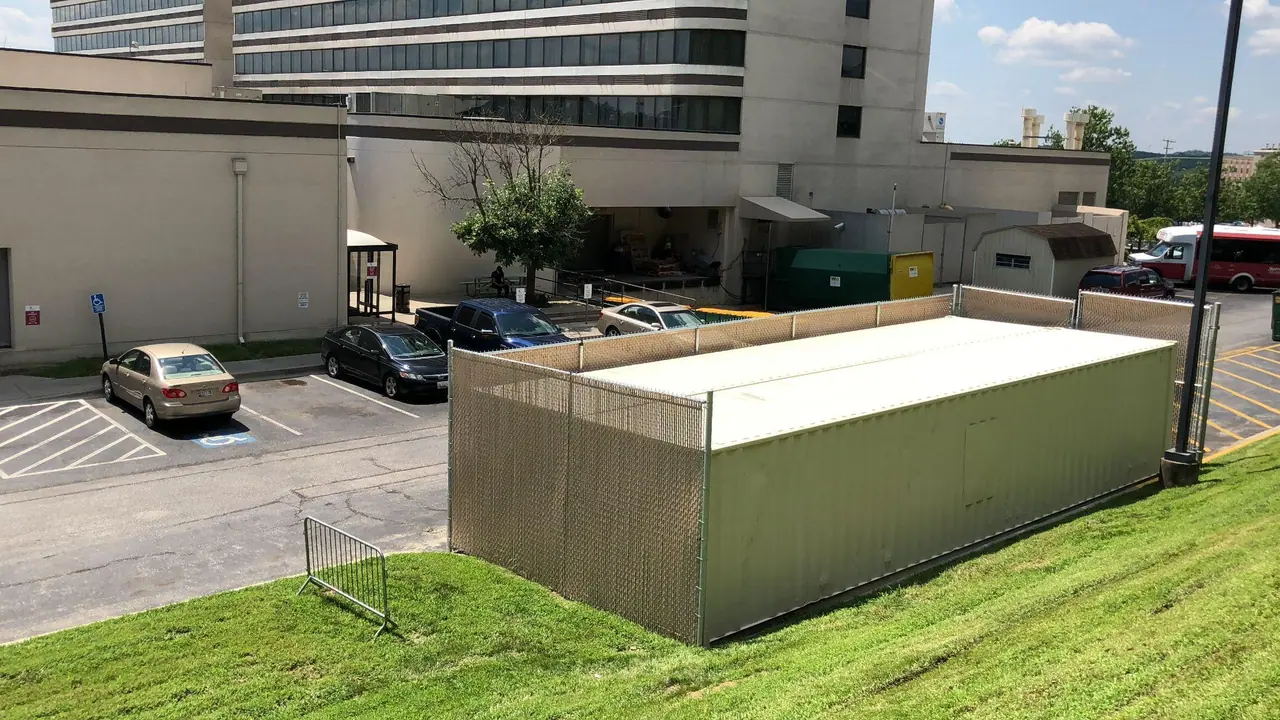
Usually if a container sits behind a building or out of sight behind a fence, most cities are fine with it.
Usually if a container sits behind a building or out of sight behind a fence, most cities are fine with it. Behind a retail building or a restaurant it will not look much different from a large dumpster or trash compactor.
Visibility drives complaints, and complaints drive enforcement. Even where containers are not expressly prohibited, a city that receives enough complaints may tell you to move it. Painting the container or relocating it to a less visible spot on the property goes a long way. We often have customers paint WWT containers to match their building so the unit blends in.
Residential Properties
Residential is trickier. Fence heights are typically lower, so containers are more visible even in a backyard. Painting helps, and a One Trip container is far less of an eyesore. If neither is an option, it is worth a conversation with your neighbors before the truck arrives.
Most cities do not have regulations prohibiting containers on residential property, but as above, if neighbors complain the city may still decide it has to move, even without a specific container rule on the books.
Research how your city treats “temporary storage structures” before you order. As a rough rule: if you can have a toolshed in your backyard, you can probably have a container in your backyard.
HOAs are a different matter. Every HOA is different, and boards can change rules quickly when neighbors are unhappy. Because it is so often a gray area, the safest move is confirming your neighbors will not be upset before you order.
Temporary Obstruction Permits
The one situation that reliably requires a permit is blocking a right of way. If you need a container on the sidewalk or in the street during a construction project, most cities will allow it with a temporary permit. The permit must be obtained before delivery and posted on the container doors immediately after, and your municipality may have additional requirements.
Preparing for Ground Level Delivery
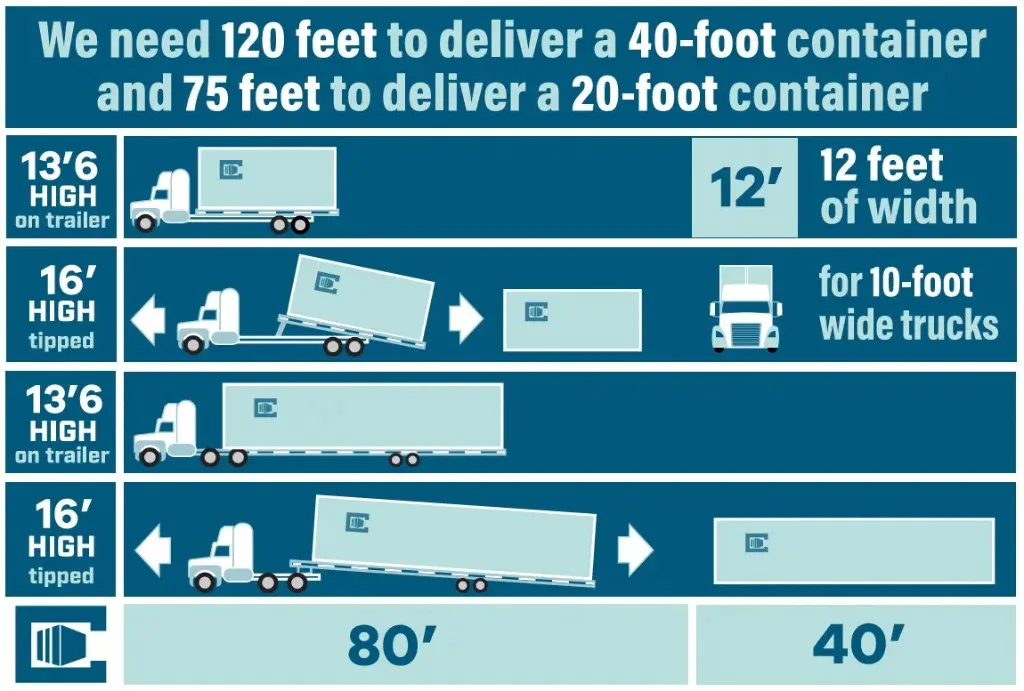
Ground level delivery requires a long, straight, unobstructed approach. The biggest issue with delivery is making sure there is enough room for the truck. Ground level delivery requires a tilt-bed truck for 20ft containers and a slide-axle trailer for 40ft containers. Full site checklist: Delivery Information.
We need 120 feet to deliver a 40-foot container and 75 feet to deliver a 20-foot container.
Insist on a Professional CDL Driver
We deliver with a semi tractor-trailer combination, which requires a CDL driver. Many of our competitors use “hot-shot” delivery trucks, which do not. Professional drivers make a difference at the point of delivery and at the depot, where the equipment gets inspected before it goes out. Hot-shot delivery may save a little money, but in our experience, it comes with real risk of a poor delivery and equipment that was never properly inspected.
Door Direction Matters
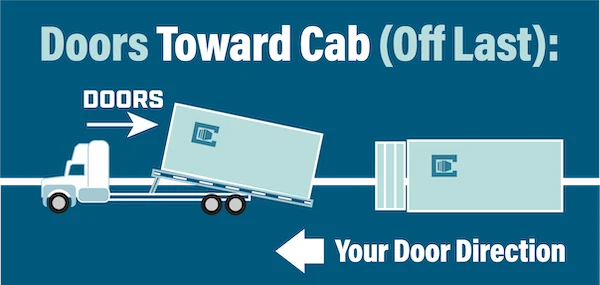
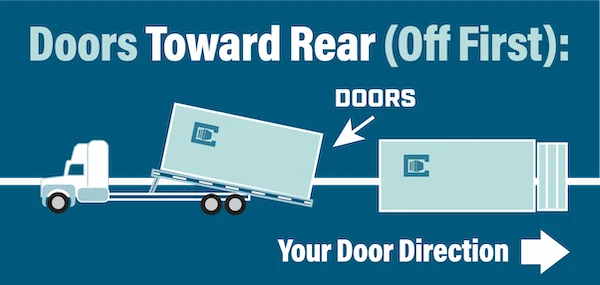
Containers are big and heavy, and they are not easy to spin around once they are on the ground without a crane. Decide which way you want the doors facing before we load the truck at the depot. See doors off first vs doors off last.
Doors toward the cab roll off last.Doors toward the rear of the trailer roll off first.
The most common setup is doors facing the cab, so they roll off last. That lets you place the bulkhead end against a wall or building if that is what your site needs. Doors are typically loaded facing the rear of the trailer only when the truck will be driving through the delivery site, such as a wide-open new construction site.
Have Wood Ready to Level Your Container
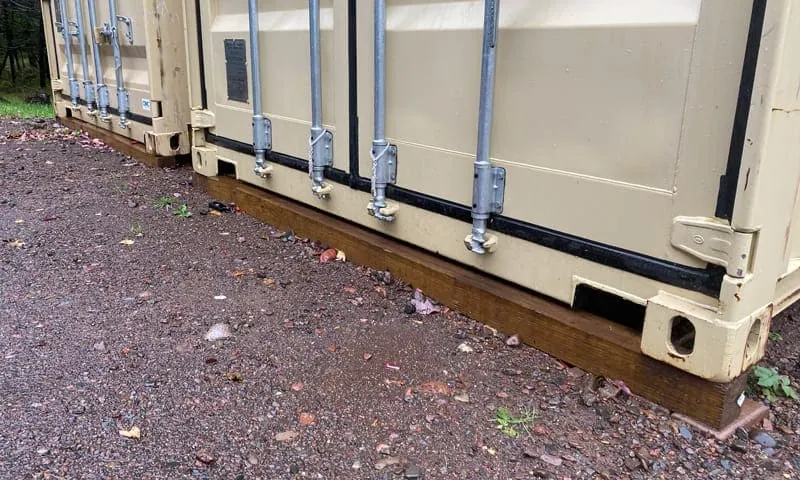
We strongly recommend having two 8ft-long 4x4s on site for the driver to set the container on as it comes off the trailer.
Containers rest on their corner castings when stacked or on a chassis, so you only need one 4x4 under each end. An 8ft 4x4 is exactly the width of the container, which keeps the doorframe square, and a square doorframe is what makes the doors operate smoothly. More on what to put under a shipping container.
Beyond keeping the doors square, setting the container on wood keeps it off the ground and prevents the steel crossmembers under the floor from sitting in standing water. Crossmembers exposed to standing water or mud will eventually fail, causing the floor to sag or break under a forklift.
Maintenance and How Long a Container Lasts
Shipping containers are built to be durable, and properly maintained they should last about as long as steel normally lasts, which is a long time. Willscot Mobile Mini, the largest storage container rental company in the U.S., depreciates its used containers over 30 years from the date of purchase, even for units bought in wind and watertight condition. Related: How long does a shipping container last?.
That means a used container in their fleet could hypothetically be 45 years old before reaching the end of its depreciated life, and still hold value above scrap if it is functioning properly. Your container should last at least that long, and probably longer with proper care.
Keep Your Container Out of Standing Water and Mud
Those crossmembers hold up the wood floor, so if they rust out the floor starts to sag and eventually fails.
As above, keeping your container slightly off the ground pays off twice: it keeps the doors square, and it keeps the steel crossmembers out of standing water and mud. Those crossmembers hold up the wood floor, so if they rust out the floor starts to sag and eventually fails.
Shipping containers are made from corten steel, so a little surface rust is not a problem, because the blended steel stops rust at the surface and prevents it from going all the way through. The main thing that defeats corten is persistent standing water. If your container sits on a surface with poor drainage or in mud, the crossmembers will eventually rust through.
The same applies to the doors and lower portion of the container if it sits in large piles of melting snow. Clear snow away from the container promptly in spring. (Snow that is not melting is not the problem. Wet is the problem.)
Placing your container on gravel or a paved surface with proper drainage prevents pooling underneath. The crossmembers also sit slightly above the corner castings, so a little water is fine. It needs to be about an inch deep before it becomes an issue.
Roof Maintenance and Dealing with Leaks
The biggest single maintenance issue is water pooling on the roof and eventually rusting through into a leak.
The easiest way to check is to step inside, shut the door behind you, and look for daylight where there should not be any.
A small hole in the roof is not a crisis and is easily patched before it becomes a bigger problem. A small leak can usually be plugged with a bead of caulk and a fresh coat of paint over the top. For anything larger, a fiberglass patch repairs the container without removing and replacing roof panels. Fiberglass patches are sometimes sold as “RV patches” and are available at most major hardware stores.
The hole on the left is too large for caulk alone.The one on the right is an easy caulk repair.
Whether you are using caulk or a fiberglass patch, prep the area first by scraping it with a paint scraper or steel wool. Go gently, because aggressive scraping can turn a small hole into a bigger one. Scrape the surface only.
Once the area is clean, apply the caulk or patch and let it cure. When it is dry, cover the repair with a direct-to-metal paint, along with any other area that looks like it is heading the same direction.
Final Checklist Before You Order
Before you order, take a few minutes to confirm you’ve picked the right container for your needs and have a plan for delivery. Here is what should be settled before we load your container at the depot.
Make sure you’re ordering the right size. Container sizes are based on outside dimensions, so a 40ft container doesn’t give you 40ft of interior storage. If you’re storing something large, check the interior dimensions and the door opening. You’ll also need room outside the container to open the doors and move things in and out.
Know what to expect your container to look like. Used containers have surface rust, dents, paint scrapes, and sometimes patches with mismatched paint. If appearance matters, plan to paint after delivery or order a One Trip container. Containers are next off the stack and color cannot be selected for WWT or CWO containers (One Trip containers are usually beige).
Tell us if you need more than basic storage. If you plan to export your container, you’ll need a CSC Survey completed at the depot. CSC Surveys cannot be completed once a container is placed on the ground because the surveyor needs to see underneath the container.
Check your local regulations. Confirm a container is allowed where you plan to put it and handle any permits ahead of delivery. If you have a landlord or an HOA, check with them too. You don’t want to find out you need to move it after it is already on the ground.
Check the total price, including delivery. Know what you are paying for the container, delivery and applicable sales tax. Make sure there are no hidden fees or extra charges. Make sure to account for any additional costs to make your site ready for delivery.
Make sure there is enough room for the truck. We ask for 75ft of total space for a 20ft container and 120ft for a 40ft container, plus clearance for the entrance, the turns and any overhead obstacles. If you’re unsure, our logistics team can review photos or video of your site.
Have your placement area ready. Your container needs a firm, level surface with good drainage. Soft ground, mud, and standing water cause problems at delivery and afterward. Have your supports on site and ready when the truck arrives.
Decide which way the doors should face. Let us know before we load the container at the depot. Doors facing the cab roll off last; doors facing the rear of the trailer roll off first.
Understand the delivery timeline and order terms. Confirm the estimated delivery date and who needs to be on site. Make sure you understand the policies for cancellation, rescheduling, and dry run fees.
Read the warranty and know who to call. Check what’s covered, what isn’t, and how to request help. Ask what to inspect on arrival. If you spot a problem, take photos and contact us before attempting a repair yourself.
Once you have worked through this list you should have a clear picture of what you need and where it is going. Most delivery problems we see trace back to one of these ten items, so a few minutes here is the best time investment you can make in the purchase.
Ready to order
You can always find live pricing and place your order online. Enter your ZIP to go to the published location page for your area.